YRC Logo
PROTEIN SEARCH:
Descriptions Names[Advanced Search]

A developmental process, independent of morphogenetic (shape) change, that is required for the cerebellar cortex to attain its fully functional state. The cerebellar cortex is a thin mantle of gray matter that covers the surface of each cerebral hemisphere. It has a characteristic morphology with convolutions (gyri) and crevices (sulci) that have specific functions. Six layers of nerve cells and the nerve pathways that connect them comprise the cerebellar cortex. Together, these regions are responsible for the processes of conscious thought, perception, emotion and memory as well as advanced motor function. A developmental process, independent of morphogenetic (shape) change, that is required for an organ to attain its fully functional state. An organ is a tissue or set of tissues that work together to perform a specific function or functions. A developmental process, independent of morphogenetic (shape) change, that is required for the cerebellar granular layer to attain its fully functional state. The granular layer is the innermost layer of the cerebellar cortex. This layer contains densely packed small neurons, mostly granule cells. Some Golgi cells are found at the outer border. Granule neurons send parallel fibers to the upper molecular layer, where they synapse with Purkinje cell dendrites. Mossy fibers from the pontine nuclei in the white matter synapse with granule cell axons, Golgi cell axons and unipolar brush interneuron axons at cerebellar glomeruli in the granule cell layer. A developmental process, independent of morphogenetic (shape) change, that is required for the pons to attain its fully functional state. The pons lies above the medulla and next to the cerebellum. The pons conveys information about movement from the cerebral hemisphere to the cerebellum. A developmental process, independent of morphogenetic (shape) change, that is required for the hindbrain to attain its fully functional state. The hindbrain is the region consisting of the medulla, pons and cerebellum. Areas of the hindbrain control motor and autonomic functions. A developmental process, independent of morphogenetic (shape) change, that is required for bone to attain its fully functional state. The biological process whose specific outcome is the progression of an anatomical structure from an initial condition to its mature state. This process begins with the formation of the structure and ends with the mature structure, whatever form that may be including its natural destruction. An anatomical structure is any biological entity that occupies space and is distinguished from its surroundings. Anatomical structures can be macroscopic such as a carpel, or microscopic such as an acrosome. A developmental process, independent of morphogenetic (shape) change, that is required for the cerebellum to attain its fully functional state. The cerebellum is the portion of the brain in the back of the head between the cerebrum and the pons. The cerebellum controls balance for walking and standing, modulates the force and range of movement and is involved in the learning of motor skills. A biological process whose specific outcome is the progression of an integrated living unit: an anatomical structure (which may be a subcellular structure, cell, tissue, or organ), or organism over time from an initial condition to a later condition. A developmental process, independent of morphogenetic (shape) change, that is required for the locus ceruleus to attain its fully functional state. The locus ceruleus is a dense cluster of neurons within the dorsorostral pons. This nucleus is the major location of neurons that release norepinephrine throughout the brain, and is responsible for physiological responses to stress and panic. A developmental process, independent of morphogenetic (shape) change, that is required for the inferior olivary nucleus to attain its fully functional state. The inferior olivary nucleus is a capsule-shaped structure in the ventral medulla located just lateral and dorsal to the medullary pyramids. Neurons in the inferior olivary nucleus are the source of climbing fiber input to the cerebellar cortex; these neurons have been implicated in various functions, such as learning and timing of movements. A developmental process, independent of morphogenetic (shape) change, that is required for the medulla oblongata to attain its fully functional state. The medulla oblongata lies directly above the spinal cord and controls vital autonomic functions such as digestion, breathing and the control of heart rate. A developmental process, independent of morphogenetic (shape) change, that is required for the central nervous system to attain its fully functional state. The central nervous system is the core nervous system that serves an integrating and coordinating function. In vertebrates it consists of the brain, spinal cord and spinal nerves. In those invertebrates with a central nervous system it typically consists of a brain, cerebral ganglia and a nerve cord. A developmental process, independent of morphogenetic (shape) change, that is required for the superior olivary nucleus to attain its fully functional state. The superior olivary nucleus is a small cylindrical mass on the dorsal surface of the lateral part of the trapezoid body of the pons, and it is situated immediately above the inferior olivary nucleus. It receives projections from the cochlear nucleus and thus is involved in the perception of sound. A developmental process, independent of morphogenetic (shape) change, that is required for an anatomical structure to attain its fully functional state. A developmental process, independent of morphogenetic (shape) change, that is required for a hair follicle to attain its fully functional state. A developmental process, independent of morphogenetic (shape) change, that is required for the midbrain-hindbrain boundary to attain its fully functional state. The midbrain-hindbrain domain of the embryonic brain is comprised of the mesencephalic vesicle and the first rhombencephalic vesicle at early somitogenesis stages. An organizing center at the boundary patterns the midbrain and hindbrain primordia of the neural plate. A developmental process, independent of morphogenetic (shape) change, that is required for a nerve to attain its fully functional state. A developmental process, independent of morphogenetic (shape) change, that is required for the olfactory placode to attain its fully functional state. The olfactory placode is a thickening of the neural ectoderm in the head region of the vertebrate embryo which develops into the olfactory region of the nasal cavity. A developmental process, independent of morphogenetic (shape) change, that is required for the cerebellar Purkinje cell layer to attain its fully functional state. The Purkinje cell layer lies just underneath the molecular layer of the cerebellar cortex. It contains the neuronal cell bodies of the Purkinje cells that are arranged side by side in a single layer. Candelabrum interneurons are vertically oriented between the Purkinje cells. Purkinje neurons are inhibitory and provide the output of the cerebellar cortex through axons that project into the white matter. Extensive dendritic trees from the Purkinje cells extend upward in a single plane into the molecular layer where they synapse with parallel fibers of granule cells. A developmental process, independent of morphogenetic (shape) change, that is required for the cerebellar molecular layer to attain its fully functional state. The molecular layer is the outermost layer of the cerebellar cortex. It contains the parallel fibers of the granule cells, interneurons such as stellate and basket cells, and the dendrites of the underlying Purkinje cells. A developmental process, independent of morphogenetic (shape) change, that is required for an anatomical structure, cell or cellular component to attain its fully functional state. A developmental process, independent of morphogenetic (shape) change, that is required for a blood vessel to attain its fully functional state.

View Gene Ontology (GO) Term

GO TERM SUMMARY

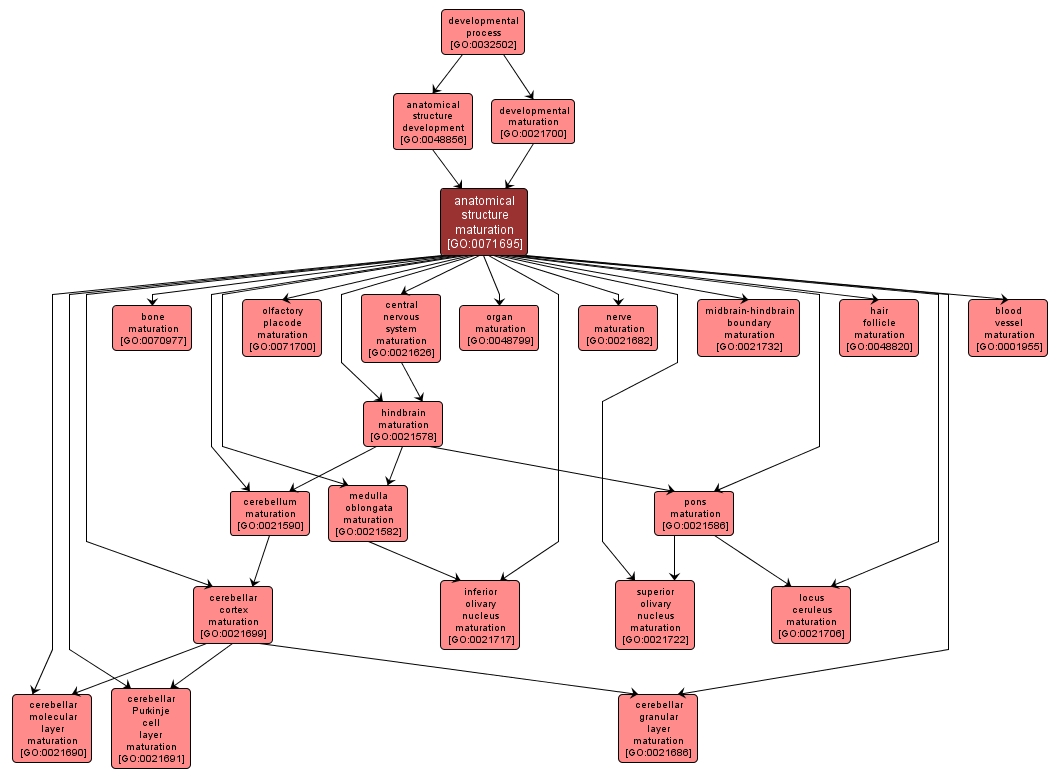
Name: anatomical structure maturation
Acc: GO:0071695
Aspect: Biological Process
Desc: A developmental process, independent of morphogenetic (shape) change, that is required for an anatomical structure to attain its fully functional state.
Proteins in PDR annotated with:
   This term: 0
   Term or descendants: 58 [Search]


[geneontology.org]
INTERACTIVE GO GRAPH

GO:0071695 - anatomical structure maturation (interactive image map)

YRC Informatics Platform - Version 3.0
Created and Maintained by: Michael Riffle