YRC Logo
PROTEIN SEARCH:
Descriptions Names[Advanced Search]

Any process by which an organism activates, maintains or increases the frequency, rate or extent of induced systemic resistance in the host organism; induced systemic resistance is a response that confers broad spectrum systemic resistance to disease and that does not depend upon salicylic acid signaling. The host is defined as the larger of the organisms involved in a symbiotic interaction. Any process by which an organism modulates the frequency, rate or extent of the immune response of a second organism, where the two organisms are in a symbiotic interaction. The immune response is any immune system process that functions in the calibrated response of an organism to a potential internal or invasive threat. Any process by which an organism activates, maintains or increases the frequency, rate or extent of the immune response of a second organism, where the two organisms are in a symbiotic interaction. The immune response is any immune system process that functions in the calibrated response of an organism to a potential internal or invasive threat. Any process by which an organism activates, maintains or increases the frequency, rate or extent of the immune response of the host organism; the immune response is any immune system process that functions in the calibrated response of an organism to a potential internal or invasive threat. The host is defined as the larger of the organisms involved in a symbiotic interaction. Any process by which an organism modulates the frequency, rate or extent of the immune response of the host organism; the immune response is any immune system process that functions in the calibrated response of an organism to a potential internal or invasive threat. The host is defined as the larger of the organisms involved in a symbiotic interaction. Any process by which an organism activates, maintains or increases the frequency, rate or extent of the jasmonic acid-mediated defense response of the host organism. The host is defined as the larger of the organisms involved in a symbiotic interaction. Any process by which an organism activates the immune response of the host organism; the immune response is any immune system process that functions in the calibrated response of an organism to a potential internal or invasive threat. The host is defined as the larger of the organisms involved in a symbiotic interaction. Any process by which an organism activates, maintains or increases the frequency, rate or extent of systemic acquired resistance in the host organism; systemic acquired resistance is a salicylic acid-mediated response that confers broad spectrum systemic resistance. The host is defined as the larger of the organisms involved in a symbiotic interaction. A change in state or activity of a cell or an organism (in terms of movement, secretion, enzyme production, gene expression, etc.) as a result of detecting the immune response of the host organism. The host is defined as the larger of the organisms involved in a symbiotic interaction. Any process by which an organism modulates the frequency, rate or extent of the defense response of its host, the response mounted by the host in response to the presence of the organism. The host is defined as the larger of the organisms involved in a symbiotic interaction. Any process by which an organism activates, maintains or increases the frequency, rate or extent of the resistance gene-dependent defense response of the host organism. The host is defined as the larger of the organisms involved in a symbiotic interaction. Any process that activates or increases the frequency, rate or extent of the immune response, the immunological reaction of an organism to an immunogenic stimulus. Any process by which an organism activates, maintains or increases the frequency, rate or extent of the production of phytoalexins as part of the defense response of the host organism. The host is defined as the larger of the organisms involved in a symbiotic interaction. Any process by which an organism activates, maintains or increases the frequency, rate or extent of the production of nitric oxide as part of the defense response of the host organism. The host is defined as the larger of the organisms involved in a symbiotic interaction. Any process by which an organism activates, maintains or increases the frequency, rate or extent of the production of reactive oxygen species as part of the defense response of the host organism. The host is defined as the larger of the organisms involved in a symbiotic interaction. Any process by which an organism activates, maintains or increases the frequency, rate or extent of the innate immune response of the host organism; the innate immune response is the host's first line of defense against infection. The host is defined as the larger of the organisms involved in a symbiotic interaction.

View Gene Ontology (GO) Term

GO TERM SUMMARY

Name: positive regulation by symbiont of host immune response
Acc: GO:0052556
Aspect: Biological Process
Desc: Any process by which an organism activates, maintains or increases the frequency, rate or extent of the immune response of the host organism; the immune response is any immune system process that functions in the calibrated response of an organism to a potential internal or invasive threat. The host is defined as the larger of the organisms involved in a symbiotic interaction.
Synonyms:
  • upregulation by symbiont of host immune response
  • up-regulation by symbiont of host immune response
  • up regulation by symbiont of host immune response
  • activation by symbiont of host immune response
  • stimulation by symbiont of host immune response
Proteins in PDR annotated with:
   This term: 0
   Term or descendants: 21 [Search]


[geneontology.org]
INTERACTIVE GO GRAPH

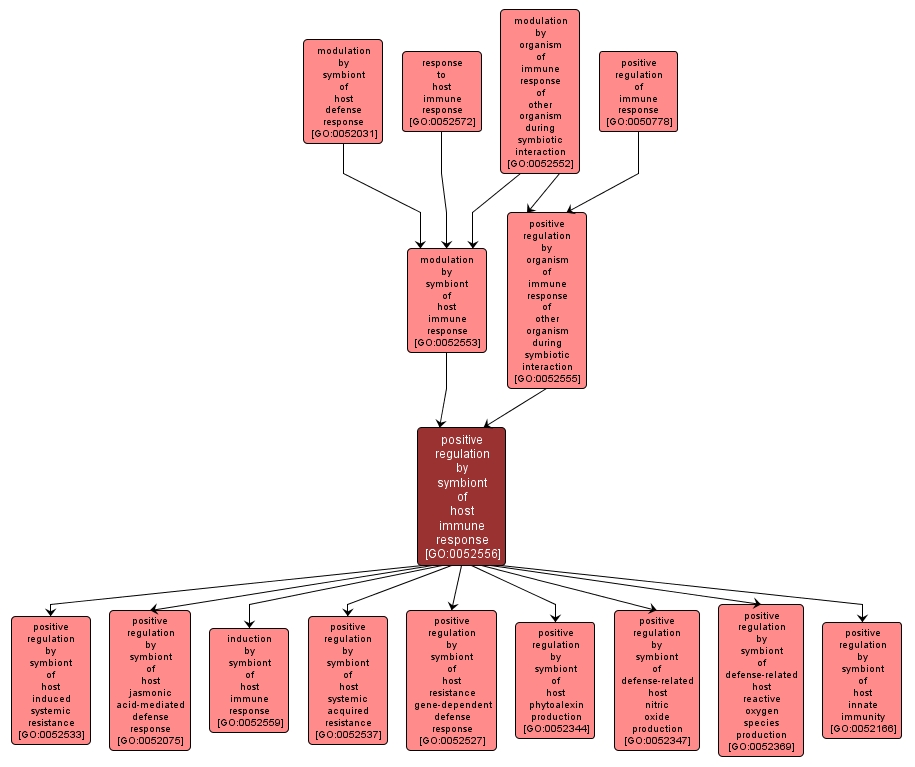
GO:0052556 - positive regulation by symbiont of host immune response (interactive image map)

YRC Informatics Platform - Version 3.0
Created and Maintained by: Michael Riffle