YRC Logo
PROTEIN SEARCH:
Descriptions Names[Advanced Search]

Any process by which an organism modulates the frequency, rate or extent of the production of nitric oxide as part of the defense response of the host organism. The host is defined as the larger of the organisms involved in a symbiotic interaction. Any process by which an organism modulates the frequency, rate or extent of the production of nitric oxide that occurs as part of the defense response of a second organism, where the two organisms are in a symbiotic interaction. Any process by which an organism activates, maintains or increases the frequency, rate or extent of the immune response of a second organism, where the two organisms are in a symbiotic interaction. The immune response is any immune system process that functions in the calibrated response of an organism to a potential internal or invasive threat. The activation by an organism of the production of nitric oxide as part of the defense response of the host organism. The host is defined as the larger of the organisms involved in a symbiotic interaction. Any process by which an organism activates, maintains or increases the frequency, rate or extent of the immune response of the host organism; the immune response is any immune system process that functions in the calibrated response of an organism to a potential internal or invasive threat. The host is defined as the larger of the organisms involved in a symbiotic interaction. A change in state or activity of a cell or an organism (in terms of movement, secretion, enzyme production, gene expression, etc.) as a result of nitric oxide produced as part of the defense response of the host organism. The host is defined as the larger of the organisms involved in a symbiotic interaction. Any process by which an organism modulates the frequency, rate or extent of the immune response of the host organism; the immune response is any immune system process that functions in the calibrated response of an organism to a potential internal or invasive threat. The host is defined as the larger of the organisms involved in a symbiotic interaction. Any process by which an organism activates, maintains or increases the frequency, rate or extent of the production of nitric oxide that occurs as part of the defense response of a second organism, where the two organisms are in a symbiotic interaction. Any process by which an organism activates, maintains or increases the frequency, rate or extent of the production of nitric oxide as part of the defense response of the host organism. The host is defined as the larger of the organisms involved in a symbiotic interaction.

View Gene Ontology (GO) Term

GO TERM SUMMARY

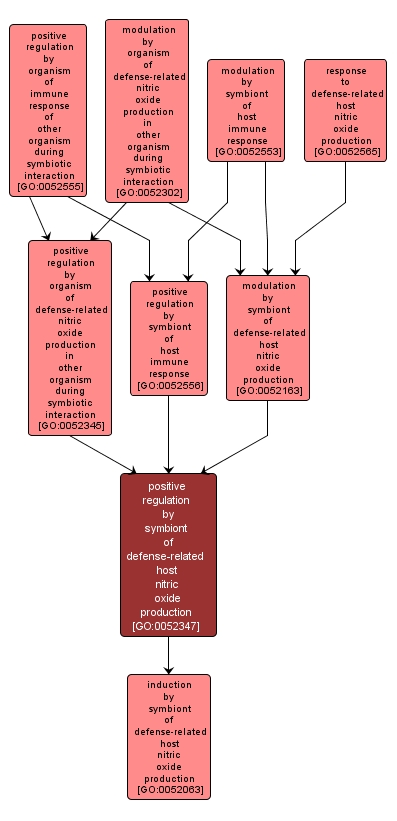
Name: positive regulation by symbiont of defense-related host nitric oxide production
Acc: GO:0052347
Aspect: Biological Process
Desc: Any process by which an organism activates, maintains or increases the frequency, rate or extent of the production of nitric oxide as part of the defense response of the host organism. The host is defined as the larger of the organisms involved in a symbiotic interaction.
Synonyms:
  • activation by symbiont of defense-related host nitric oxide production
  • upregulation by symbiont of defense-related host nitric oxide production
  • up-regulation by symbiont of defense-related host nitric oxide production
  • stimulation by symbiont of defense-related host nitric oxide production
  • up regulation by symbiont of defense-related host nitric oxide production
  • positive regulation by organism of defense-related host NO production
Proteins in PDR annotated with:
   This term: 0
   Term or descendants: 1 [Search]


[geneontology.org]
INTERACTIVE GO GRAPH

GO:0052347 - positive regulation by symbiont of defense-related host nitric oxide production (interactive image map)

YRC Informatics Platform - Version 3.0
Created and Maintained by: Michael Riffle