YRC Logo
PROTEIN SEARCH:
Descriptions Names[Advanced Search]

Self-propelled movement of a cell or organism from one location to another. The directional movement of an organism from one place to another within a second organism, where the two organisms are in a symbiotic interaction. The process by which an organism or its progeny spreads from one location to another within a second organism, where the two organisms are in a symbiotic interaction. The directed movement of a motile cell or organism in response to a specific chemical concentration gradient within a second organism, where the two organisms are in a symbiotic interaction. The directed movement of a motile cell or organism within a second organism in response to physical parameters involved in energy generation, such as light, oxygen, and oxidizable substrates, where the two organisms are in a symbiotic interaction. The process by which an organism or its progeny spreads from one location to another within its host organism. The host is defined as the larger of the organisms involved in a symbiotic interaction. The directed movement of an organism or motile cell on, within or near a second organism, where the two organisms are in a symbiotic interaction. An interaction between two organisms living together in more or less intimate association. The term host is usually used for the larger (macro) of the two members of a symbiosis. The smaller (micro) member is called the symbiont organism. Microscopic symbionts are often referred to as endosymbionts. The various forms of symbiosis include parasitism, in which the association is disadvantageous or destructive to one of the organisms; mutualism, in which the association is advantageous, or often necessary to one or both and not harmful to either; and commensalism, in which one member of the association benefits while the other is not affected. However, mutualism, parasitism, and commensalism are often not discrete categories of interactions and should rather be perceived as a continuum of interaction ranging from parasitism to mutualism. In fact, the direction of a symbiotic interaction can change during the lifetime of the symbionts due to developmental changes as well as changes in the biotic/abiotic environment in which the interaction occurs.

View Gene Ontology (GO) Term

GO TERM SUMMARY

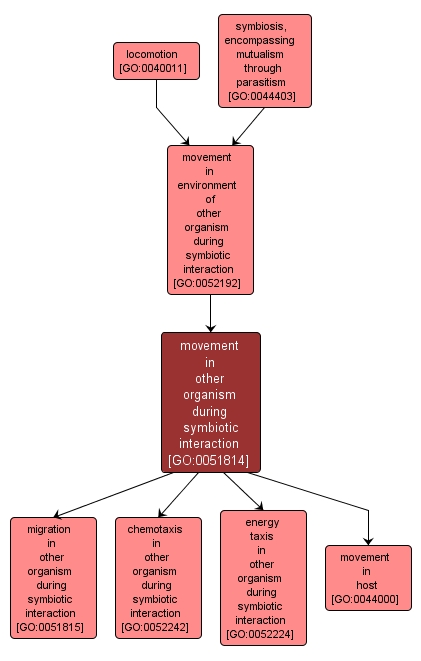
Name: movement in other organism during symbiotic interaction
Acc: GO:0051814
Aspect: Biological Process
Desc: The process by which an organism or its progeny spreads from one location to another within a second organism, where the two organisms are in a symbiotic interaction.
Synonyms:
  • movement within other organism during symbiotic interaction
Proteins in PDR annotated with:
   This term: 0
   Term or descendants: 3 [Search]


[geneontology.org]
INTERACTIVE GO GRAPH

GO:0051814 - movement in other organism during symbiotic interaction (interactive image map)

YRC Informatics Platform - Version 3.0
Created and Maintained by: Michael Riffle