YRC Logo
PROTEIN SEARCH:
Descriptions Names[Advanced Search]

The orderly movement of a cell from one site to another, often during the development of a multicellular organism or multicellular structure. The migration of a cluster of a relatively undifferentiated cell along the developing anterior lateral line, originating from cranial ectodermal placodes situated between the eye and the ear. The neuromast primordium deposits proneuromasts along the lateral line, from which the neuromasts will develop. Any process involved in the controlled self-propelled movement of a cell that results in translocation of the cell from one place to another. The migration of a relatively undifferentiated cell along the developing posterior lateral line, originating from cranial ectodermal placodes situated behind the ear. The neuromast primordium deposits proneuromasts along the lateral line, from which the neuromasts will develop. The biological process whose specific outcome is the progression of an anatomical structure from an initial condition to its mature state. This process begins with the formation of the structure and ends with the mature structure, whatever form that may be including its natural destruction. An anatomical structure is any biological entity that occupies space and is distinguished from its surroundings. Anatomical structures can be macroscopic such as a carpel, or microscopic such as an acrosome. The process whose specific outcome is the progression of the lateral line system over time, from its formation to the mature structure. The lateral line system is a network of sensory organs (neuromasts) and lateral line nerves located superficially on the skin or just under the skin in fluid-filled canals on the head and body of all fishes and most amphibians. The lateral line system develops from cranial ectodermal placodes situated between the eye and ear. The process whose specific outcome is the progression of the lateral line over time, from its formation to the mature structure. The lateral line consists of small sensory patches (neuromasts) located superficially on the skin or just under the skin in fluid-filled canals on the head and body of all fishes and most amphibians. The lateral line develops from cranial ectodermal placodes situated behind the ear and between the eye and ear. The migration of a cluster of a relatively undifferentiated cell originating at specific cephalic placodes and depositing proneuromasts along a developing lateral line, from which the neuromasts will develop.

View Gene Ontology (GO) Term

GO TERM SUMMARY

Name: neuromast primordium migration
Acc: GO:0048883
Aspect: Biological Process
Desc: The migration of a cluster of a relatively undifferentiated cell originating at specific cephalic placodes and depositing proneuromasts along a developing lateral line, from which the neuromasts will develop.
Synonyms:
  • lateral line primordium migration
Proteins in PDR annotated with:
   This term: 0
   Term or descendants: 5 [Search]


[geneontology.org]
INTERACTIVE GO GRAPH

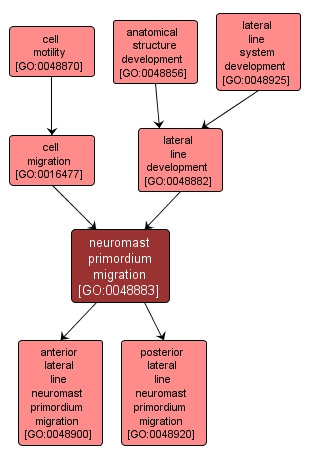
GO:0048883 - neuromast primordium migration (interactive image map)

YRC Informatics Platform - Version 3.0
Created and Maintained by: Michael Riffle