YRC Logo
PROTEIN SEARCH:
Descriptions Names[Advanced Search]

The process pertaining to the initial formation of an organ from unspecified parts. The process begins with the specific processes that contribute to the appearance of the discrete structure, such as inductive events, and ends when the structural rudiment of the organ is recognizable, such as a condensation of mesenchymal cells into the organ rudiment. Organs are a natural part or structure in an animal or a plant, capable of performing some special action (termed its function), which is essential to the life or well-being of the whole. The heart and lungs are organs of animals, and the petal and leaf are organs of plants. In animals the organs are generally made up of several tissues, one of which usually predominates, and determines the principal function of the organ. The regionalization process that specifies organ primordium boundaries resulting in a restriction of organogenesis to a limited spatial domain and keeping the organ separate from surrounding tissues. Any process that modulates the frequency, rate or extent of a multicellular organismal process, the processes pertinent to the function of a multicellular organism above the cellular level; includes the integrated processes of tissues and organs. Any process that modulates the frequency, rate or extent of anatomical structure morphogenesis. Any process that modulates the frequency, rate or extent of salivary gland determination. Any process that stops, prevents or reduces the frequency, rate or extent of salivary gland determination. Determination of where the salivary gland forms, the total number of salivary gland cells and how many cells are allocated to each of the specialised cell types within the salivary gland. Any process that activates or increases the frequency, rate or extent of salivary gland determination. The process whose specific outcome is the progression of the salivary gland over time, from its formation to the mature structure. Salivary glands include any of the saliva-secreting exocrine glands of the oral cavity. Any process that modulates the frequency, rate or extent of salivary gland determination in an adult organism. Any process that modulates the rate, frequency or extent of organ formation. Organ formation is the process pertaining to the initial formation of an organ from unspecified parts. The process begins with the specific processes that contribute to the appearance of the discrete structure, such as inductive events, and ends when the structural rudiment of the organ is recognizable, such as a condensation of mesenchymal cells into the organ rudiment. Any process that modulates the frequency, rate or extent of salivary gland determination in a larval organism.

View Gene Ontology (GO) Term

GO TERM SUMMARY

Name: regulation of salivary gland boundary specification
Acc: GO:0045704
Aspect: Biological Process
Desc: Any process that modulates the frequency, rate or extent of salivary gland determination.
Synonyms:
  • regulation of salivary gland determination
Proteins in PDR annotated with:
   This term: 0
   Term or descendants: 27 [Search]


[geneontology.org]
INTERACTIVE GO GRAPH

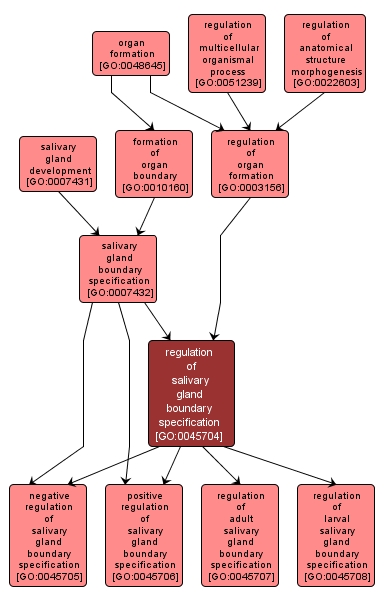
GO:0045704 - regulation of salivary gland boundary specification (interactive image map)

YRC Informatics Platform - Version 3.0
Created and Maintained by: Michael Riffle