YRC Logo
PROTEIN SEARCH:
Descriptions Names[Advanced Search]

Any process by which the symbiont regulates the increase in its size or mass within the cells or tissues of the host organism. This may (but not necessarily) include a filamentous growth form, and also can include secretion of proteases and lipases to break down. The host is defined as the larger of the organisms involved in the symbiotic interaction. Any process by which the symbiont activates, maintains or increases its size or mass within the cells or tissues of the host organism. The host is defined as the larger of the organisms involved in the symbiotic interaction. The increase in size or mass of an organism, occurring within the cells or tissues of the host organism. This may (but not necessarily) include a filamentous growth form, and also can include secretion of proteases and lipases to break down host tissue. The host is defined as the larger of the organisms involved in a symbiotic interaction. Any process that modulates the frequency, rate or extent of a biological process. Biological processes are regulated by many means; examples include the control of gene expression, protein modification or interaction with a protein or substrate molecule. The increase in size or mass of an organism, occurring in, on or near the exterior of its host organism. The host is defined as the larger of the organisms involved in a symbiotic interaction. Any process that modulates the frequency, rate or extent of symbiosis, an interaction between two organisms living together in more or less intimate association. Any process that modulates the frequency, rate or extent of a multi-organism process, a process by which an organism has an effect on another organism of the same or different species. Any process by which the symbiont stops, prevents or reduces its increase in size or mass within the cells or tissues of the host organism. The host is defined as the larger of the organisms involved in the symbiotic interaction. The increase in size or mass of an entire organism, a part of an organism or a cell. Any process that modulates the frequency, rate or extent of the growth of all or part of an organism so that it occurs at its proper speed, either globally or in a specific part of the organism's development. An interaction between two organisms living together in more or less intimate association. The term host is usually used for the larger (macro) of the two members of a symbiosis. The smaller (micro) member is called the symbiont organism. Microscopic symbionts are often referred to as endosymbionts. The various forms of symbiosis include parasitism, in which the association is disadvantageous or destructive to one of the organisms; mutualism, in which the association is advantageous, or often necessary to one or both and not harmful to either; and commensalism, in which one member of the association benefits while the other is not affected. However, mutualism, parasitism, and commensalism are often not discrete categories of interactions and should rather be perceived as a continuum of interaction ranging from parasitism to mutualism. In fact, the direction of a symbiotic interaction can change during the lifetime of the symbionts due to developmental changes as well as changes in the biotic/abiotic environment in which the interaction occurs.

View Gene Ontology (GO) Term

GO TERM SUMMARY

Name: regulation of growth of symbiont in host
Acc: GO:0044126
Aspect: Biological Process
Desc: Any process by which the symbiont regulates the increase in its size or mass within the cells or tissues of the host organism. This may (but not necessarily) include a filamentous growth form, and also can include secretion of proteases and lipases to break down. The host is defined as the larger of the organisms involved in the symbiotic interaction.
Proteins in PDR annotated with:
   This term: 0
   Term or descendants: 39 [Search]


[geneontology.org]
INTERACTIVE GO GRAPH

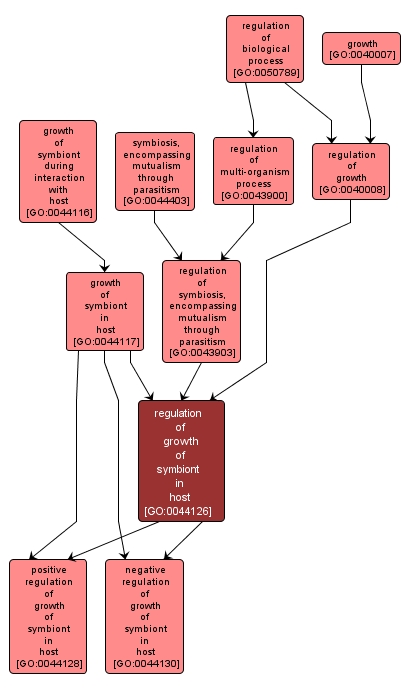
GO:0044126 - regulation of growth of symbiont in host (interactive image map)

YRC Informatics Platform - Version 3.0
Created and Maintained by: Michael Riffle