YRC Logo
PROTEIN SEARCH:
Descriptions Names[Advanced Search]

Any thylakoid within a plastid. The volume enclosed by a plastid thylakoid membrane. A compartment that consists of a lumen and an enclosing membrane, and is part of an organelle. Underdeveloped thylakoids found in etioplasts, lacking competent photosynthetic membranes. Rapidly develop into mature thylakoids in the presence of light. A thylakoid found in a cyanelle, which is a type of plastid found in certain algae. The cyanelle contains a photosynthetic membrane resembling that of cyanobacteria. Any member of a family of organelles found in the cytoplasm of plants and some protists, which are membrane-bounded and contain DNA. Plant plastids develop from a common type, the proplastid. Any constituent part of the cytoplasm, all of the contents of a cell excluding the plasma membrane and nucleus, but including other subcellular structures. Any constituent part of a plastid, a member of a family of organelles found in the cytoplasm of plants and some protists, which are membrane-bounded and contain DNA. Plant plastids develop from a common type, the proplastid. An NADH dehydrogenase complex that catalyzes the transfer of electrons to plastoquinone. The complex is involved in the non-photochemical reduction of plastoquinones and the cyclic electron transport around photosystem I, and is found in plastid thylakoids. A constituent part of an intracellular organelle, an organized structure of distinctive morphology and function, occurring within the cell. Includes constituent parts of the nucleus, mitochondria, plastids, vacuoles, vesicles, ribosomes and the cytoskeleton but excludes the plasma membrane. Organized structure of distinctive morphology and function, bounded by a single or double lipid bilayer membrane. Includes the nucleus, mitochondria, plastids, vacuoles, and vesicles. Excludes the plasma membrane. Sac-like membranous structures (cisternae) in a chloroplast combined into stacks (grana) and present singly in the stroma (stroma thylakoids or frets) as interconnections between grana. An example of this component is found in Arabidopsis thaliana. A membranous cellular structure that bears the photosynthetic pigments in plants, algae, and cyanobacteria. In cyanobacteria thylakoids are of various shapes and are attached to, or continuous with, the plasma membrane. In eukaryotes they are flattened, membrane-bounded disk-like structures located in the chloroplasts; in the chloroplasts of higher plants the thylakoids form dense stacks called grana. Isolated thylakoid preparations can carry out photosynthetic electron transport and the associated phosphorylation. Any constituent part of the living contents of a cell; the matter contained within (but not including) the plasma membrane, usually taken to exclude large vacuoles and masses of secretory or ingested material. In eukaryotes it includes the nucleus and cytoplasm. The lipid bilayer membrane of any thylakoid within a plastid.

View Gene Ontology (GO) Term

GO TERM SUMMARY

Name: plastid thylakoid
Acc: GO:0031976
Aspect: Cellular Component
Desc: Any thylakoid within a plastid.
Proteins in PDR annotated with:
   This term: 0
   Term or descendants: 338 [Search]


[geneontology.org]
INTERACTIVE GO GRAPH

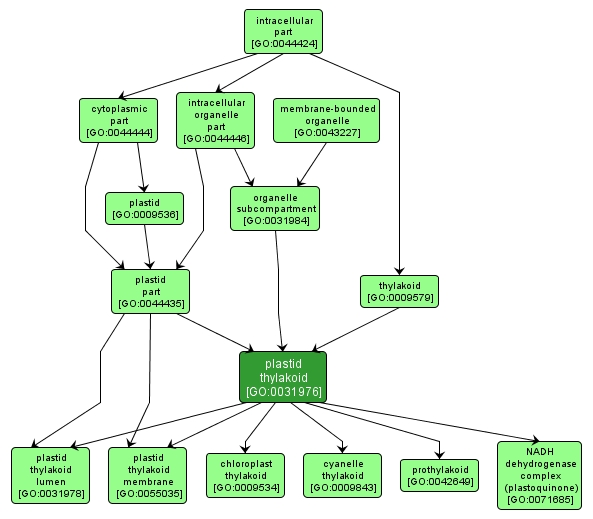
GO:0031976 - plastid thylakoid (interactive image map)

YRC Informatics Platform - Version 3.0
Created and Maintained by: Michael Riffle