YRC Logo
PROTEIN SEARCH:
Descriptions Names[Advanced Search]

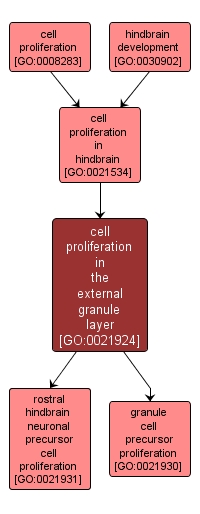
The multiplication or reproduction of cells, resulting in the expansion of a cell population in the hindbrain. The multiplication or reproduction of neuroblasts resulting in the expansion of a cell population in the external granule layer of the hindbrain. The external granule layer is the layer that originates from the rostral half of the rhombic lip in the first rhombomere. The multiplication or reproduction of cells, resulting in the expansion of a cell population. The multiplication or reproduction of neuroblasts that will give rise to neurons of the lateral pontine nucleus and the locus ceruleus. The process whose specific outcome is the progression of the hindbrain over time, from its formation to the mature structure. The hindbrain is the posterior of the three primary divisions of the developing chordate brain, or the corresponding part of the adult brain (in vertebrates, includes the cerebellum, pons, and medulla oblongata and controls the autonomic functions and equilibrium). The multiplication or reproduction of neuroblasts that will give rise to granule cells. A granule cell is a glutamatergic interneuron found in the cerebellar cortex.

View Gene Ontology (GO) Term

GO TERM SUMMARY

Name: cell proliferation in the external granule layer
Acc: GO:0021924
Aspect: Biological Process
Desc: The multiplication or reproduction of neuroblasts resulting in the expansion of a cell population in the external granule layer of the hindbrain. The external granule layer is the layer that originates from the rostral half of the rhombic lip in the first rhombomere.
Proteins in PDR annotated with:
   This term: 0
   Term or descendants: 14 [Search]


[geneontology.org]
INTERACTIVE GO GRAPH

GO:0021924 - cell proliferation in the external granule layer (interactive image map)

YRC Informatics Platform - Version 3.0
Created and Maintained by: Michael Riffle