YRC Logo
PROTEIN SEARCH:
Descriptions Names[Advanced Search]

The process whose specific outcome is the progression of the brain over time, from its formation to the mature structure. Brain development begins with patterning events in the neural tube and ends with the mature structure that is the center of thought and emotion. The brain is responsible for the coordination and control of bodily activities and the interpretation of information from the senses (sight, hearing, smell, etc.). The process whereby a relatively unspecialized cell acquires specialized features of a neuron that will reside in the forebrain. The process whereby neuroepithelial cells in the neural tube acquire specialized structural and/or functional features of basal progenitor cells, neuroblasts that lose their contacts with the ventricular surface. Differentiation includes the processes involved in commitment of a cell to a specific fate. The process by which nerve cells are generated. This includes the production of neuroblasts and their differentiation into neurons. The process whose specific outcome is the progression of the forebrain over time, from its formation to the mature structure. The forebrain is the anterior of the three primary divisions of the developing chordate brain or the corresponding part of the adult brain (in vertebrates, includes especially the cerebral hemispheres, the thalamus, and the hypothalamus and especially in higher vertebrates is the main control center for sensory and associative information processing, visceral functions, and voluntary motor functions). The process by which nerve cells are generated in the forebrain. This includes the production of neuroblasts from and their differentiation into neurons. The division of a neuroblast located in the forebrain. Neuroblast division gives rise to at least another neuroblast. The biological process whose specific outcome is the progression of an anatomical structure from an initial condition to its mature state. This process begins with the formation of the structure and ends with the mature structure, whatever form that may be including its natural destruction. An anatomical structure is any biological entity that occupies space and is distinguished from its surroundings. Anatomical structures can be macroscopic such as a carpel, or microscopic such as an acrosome. The process whereby neuroepithelial cells of the neural tube give rise to radial glial cells, specialized bipotential progenitors cells of the forebrain. Differentiation includes the processes involved in commitment of a cell to a specific fate. Generation of cells within the nervous system.

View Gene Ontology (GO) Term

GO TERM SUMMARY

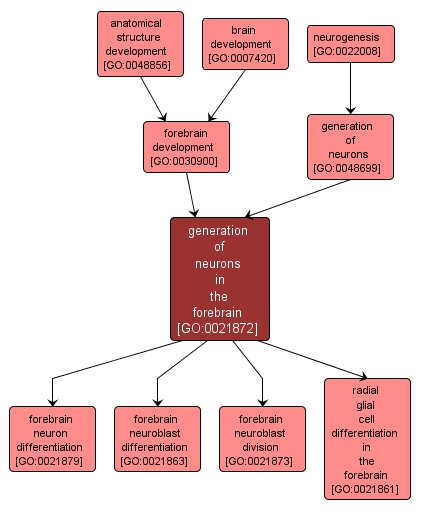
Name: generation of neurons in the forebrain
Acc: GO:0021872
Aspect: Biological Process
Desc: The process by which nerve cells are generated in the forebrain. This includes the production of neuroblasts from and their differentiation into neurons.
Proteins in PDR annotated with:
   This term: 0
   Term or descendants: 42 [Search]


[geneontology.org]
INTERACTIVE GO GRAPH

GO:0021872 - generation of neurons in the forebrain (interactive image map)

YRC Informatics Platform - Version 3.0
Created and Maintained by: Michael Riffle