YRC Logo
PROTEIN SEARCH:
Descriptions Names[Advanced Search]

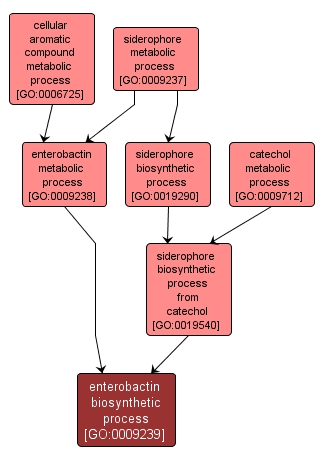
The chemical reactions and pathways involving siderophores, low molecular weight Fe(III)-chelating substances made by aerobic or facultatively anaerobic bacteria, especially when growing under iron deficient conditions. The complexes of Fe(3+)-siderophores have very high stability constants and are taken up by specific transport systems by microorganisms; the subsequent release of iron requires enzymatic action. The chemical reactions and pathways involving aromatic compounds, any organic compound characterized by one or more planar rings, each of which contains conjugated double bonds and delocalized pi electrons, as carried out by individual cells. The chemical reactions and pathways involving enterobactin, a catechol-derived siderochrome of Enterobacteria; enterobactin (N',N',N''-(2,6,10-trioxo-1,5,9-triacyclodecane-3,7,11-triyl)tris(2,3-dihydroxy)benzamide) is a self-triester of 2,3-dihydroxy-N-benzoyl-L-serine and a product of the shikimate pathway. The chemical reactions and pathways resulting in the formation of enterobactin, a catechol-derived siderochrome of Enterobacteria; enterobactin (N',N',N''-(2,6,10-trioxo-1,5,9-triacyclodecane-3,7,11-triyl)tris(2,3-dihydroxy)benzamide) is a self-triester of 2,3-dihydroxy-N-benzoyl-L-serine and a product of the shikimate pathway. The chemical reactions and pathways resulting in the formation of a siderophore from other compounds, including catechol. The chemical reactions and pathways involving a compound containing a pyrocatechol (1,2-benzenediol) nucleus or substituent. The chemical reactions and pathways resulting in the formation of siderophores, low molecular weight Fe(III)-chelating substances made by aerobic or facultatively anaerobic bacteria, especially when growing under iron deficient conditions. The complexes of Fe(3+)-siderophores have very high stability constants and are taken up by specific transport systems by microorganisms; the subsequent release of iron requires enzymatic action.

View Gene Ontology (GO) Term

GO TERM SUMMARY

Name: enterobactin biosynthetic process
Acc: GO:0009239
Aspect: Biological Process
Desc: The chemical reactions and pathways resulting in the formation of enterobactin, a catechol-derived siderochrome of Enterobacteria; enterobactin (N',N',N''-(2,6,10-trioxo-1,5,9-triacyclodecane-3,7,11-triyl)tris(2,3-dihydroxy)benzamide) is a self-triester of 2,3-dihydroxy-N-benzoyl-L-serine and a product of the shikimate pathway.
Synonyms:
  • enterobactin biosynthesis
  • GO:0031192
  • GO:0031191
  • enterobactin biosynthetic process, peptide modification
  • enterochelin biosynthesis
  • enterobactin synthesis
  • enterobactin synthetase
  • enterobactin formation
  • enterochelin biosynthetic process
  • enterobactin anabolism
  • enterobactin biosynthetic process, peptide formation
Proteins in PDR annotated with:
   This term: 7 [Search]
   Term or descendants: 7 [Search]


[geneontology.org]
INTERACTIVE GO GRAPH

GO:0009239 - enterobactin biosynthetic process (interactive image map)

YRC Informatics Platform - Version 3.0
Created and Maintained by: Michael Riffle