YRC Logo
PROTEIN SEARCH:
Descriptions Names[Advanced Search]

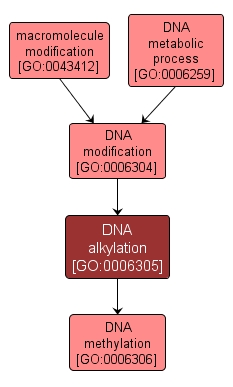
The covalent transfer of a methyl group to either N-6 of adenine or C-5 or N-4 of cytosine. The addition of alkyl groups to many positions on all four bases of DNA. Alkylating agents can also modify the bases of incoming nucleotides in the course of DNA synthesis. The covalent alteration of one or more monomeric units in a polypeptide, polynucleotide, polysaccharide, or other biological macromolecule, resulting in a change in its properties. Any cellular metabolic process involving deoxyribonucleic acid. This is one of the two main types of nucleic acid, consisting of a long, unbranched macromolecule formed from one, or more commonly, two, strands of linked deoxyribonucleotides. The covalent alteration of one or more nucleotide sites in DNA, resulting in a change in its properties.

View Gene Ontology (GO) Term

GO TERM SUMMARY

Name: DNA alkylation
Acc: GO:0006305
Aspect: Biological Process
Desc: The addition of alkyl groups to many positions on all four bases of DNA. Alkylating agents can also modify the bases of incoming nucleotides in the course of DNA synthesis.
Proteins in PDR annotated with:
   This term: 0
   Term or descendants: 119 [Search]


[geneontology.org]
INTERACTIVE GO GRAPH

GO:0006305 - DNA alkylation (interactive image map)

YRC Informatics Platform - Version 3.0
Created and Maintained by: Michael Riffle