YRC Logo
PROTEIN SEARCH:
Descriptions Names[Advanced Search]

The change in morphology and behavior of a mature or immature B cell resulting from exposure to a mitogen, cytokine, chemokine, cellular ligand, or an antigen for which it is specific. The process whereby a precursor cell type acquires the specialized features of a B cell. The process whereby transitional stage B cells acquire the specialized features of mature B cells in the spleen. The process whereby a B cell acquires the specialized features of a plasma cell. A plasma cell is a lymphocyte which develops from a B cell and produces high amounts of antibody. The process whereby a B cell in the spleen acquires the specialized features of a follicular B cell. Follicular B cells are major population of mature recirculating B cells in the spleen and are located in the B-cell follicle region. A change in morphology and behavior of a lymphocyte resulting from exposure to a specific antigen, mitogen, cytokine, chemokine, cellular ligand, or soluble factor, leading to the initiation or perpetuation of an immune response. The process whereby a B cell acquires the specialized features of a memory B cell. Memory B cells are cells that can respond rapidly to antigen re-exposure by production of high-affinity antibody. The process whereby a nave B cell acquires the specialized features of a mature or memory B cell during an immune response. The change in morphology and behavior of a mature or immature B cell during an immune response, resulting from exposure to a mitogen, cytokine, chemokine, cellular ligand, or an antigen for which it is specific. The process whereby a B cell in the spleen acquires the specialized features of a marginal zone B cell. Marginal zone B cells are localized in a distinct anatomical region of the spleen that represents the major antigen-filtering and scavenging area (by specialized macrophages resident there). It appears that they are preselected to express a BCR repertoire similar to B-1 B cells, biased toward bacterial cell wall constituents and senescent self-components (such as oxidized LDL). The process whereby a B cell in the spleen acquires the specialized features of a germinal center B cell. Germinal center B cells are rapidly cycling B cells which have downregulated IgD expression and exhibit high levels of binding by peanut agglutinin (PNA).

View Gene Ontology (GO) Term

GO TERM SUMMARY

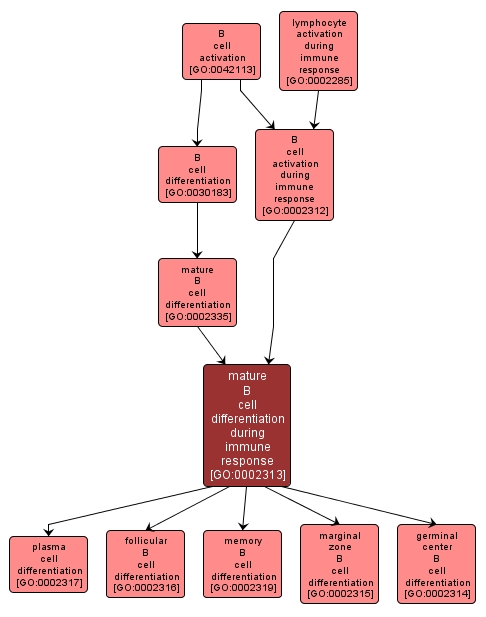
Name: mature B cell differentiation during immune response
Acc: GO:0002313
Aspect: Biological Process
Desc: The process whereby a nave B cell acquires the specialized features of a mature or memory B cell during an immune response.
Synonyms:
  • mature B lymphocyte differentiation during immune response
  • mature B-cell differentiation during immune response
  • mature B-lymphocyte differentiation during immune response
Proteins in PDR annotated with:
   This term: 0
   Term or descendants: 5 [Search]


[geneontology.org]
INTERACTIVE GO GRAPH

GO:0002313 - mature B cell differentiation during immune response (interactive image map)

YRC Informatics Platform - Version 3.0
Created and Maintained by: Michael Riffle