YRC Logo
PROTEIN SEARCH:
Descriptions Names[Advanced Search]

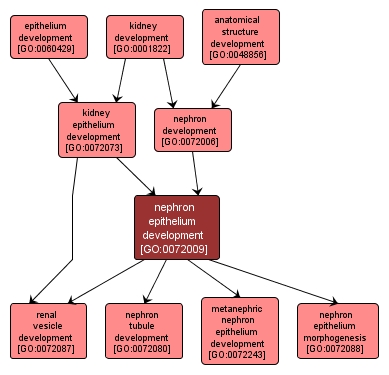
The process whose specific outcome is the progression of an epithelium over time, from its formation to the mature structure. An epithelium is a tissue that covers the internal or external surfaces of an anatomical structure. The process whose specific outcome is the progression of the nephron epithelium over time, from its formation to the mature structure. An epithelium is a tissue that covers the internal or external surfaces of an anatomical structure. The nephron epithelium is a tissue that covers the surface of a nephron. The progression of a nephron tubule over time, from its initial formation to the mature structure. A nephron tubule is an epithelial tube that is part of the nephron, the functional part of the kidney. The process whose specific outcome is the progression of the kidney over time, from its formation to the mature structure. The kidney is an organ that filters the blood and/or excretes the end products of body metabolism in the form of urine. The process whose specific outcome is the progression of an epithelium in the kidney over time, from its formation to the mature structure. An epithelium is a tissue that covers the internal or external surfaces of an anatomical structure. The process whose specific outcome is the progression of the nephron over time, from its formation to the mature structure. A nephron is the functional unit of the kidney. The process whose specific outcome is the progression of the metanephric nephron epithelium over time, from its formation to the mature structure. An epithelium is a tissue that covers the internal or external surfaces of an anatomical structure. The metanephric nephron epithelium is a tissue that covers the surface of a nephron in the metanephros. The biological process whose specific outcome is the progression of an anatomical structure from an initial condition to its mature state. This process begins with the formation of the structure and ends with the mature structure, whatever form that may be including its natural destruction. An anatomical structure is any biological entity that occupies space and is distinguished from its surroundings. Anatomical structures can be macroscopic such as a carpel, or microscopic such as an acrosome. The process whose specific outcome is the progression of the renal vesicle over time, from its formation to the mature structure. An epithelium is a tissue that covers the internal or external surfaces of an anatomical structure. The renal vesicle is the primordial structure of the nephron epithelium, and is formed by the condensation of mesenchymal cells. The process by which the anatomical structures of the nephron epithelium are generated and organized. Morphogenesis pertains to the creation of form. The nephron epithelium is a tissue that covers the surface of a nephron.

View Gene Ontology (GO) Term

GO TERM SUMMARY

Name: nephron epithelium development
Acc: GO:0072009
Aspect: Biological Process
Desc: The process whose specific outcome is the progression of the nephron epithelium over time, from its formation to the mature structure. An epithelium is a tissue that covers the internal or external surfaces of an anatomical structure. The nephron epithelium is a tissue that covers the surface of a nephron.
Proteins in PDR annotated with:
   This term: 0
   Term or descendants: 21 [Search]


[geneontology.org]
INTERACTIVE GO GRAPH

GO:0072009 - nephron epithelium development (interactive image map)

YRC Informatics Platform - Version 3.0
Created and Maintained by: Michael Riffle