YRC Logo
PROTEIN SEARCH:
Descriptions Names[Advanced Search]

Repression of transcription by altering the structure of chromatin, e.g. by conversion of large regions of DNA into an inaccessible state often called heterochromatin. Cleavage of double-stranded RNA molecules by an RNaseIII-family enzyme to produce small RNAs (generally 20-30 nucleotides, depending on species) with biological function. Any process that modulates the frequency, rate or extent of the production of siRNA, the cleavage of double-stranded RNA to form small interfering RNA molecules (siRNAs) of 21-23 nucleotides, in the context of chromatin silencing by small RNA. Any process by which RNA molecules inactivate expression of target genes. Repression of transcription by conversion of large regions of DNA into heterochromatin, directed by small RNAs sharing sequence identity to the repressed region. The process by which a double-stranded RNA precursor is processed into short (20-30 nt) fragments. RNA cleavage is catalyzed by a Dicer endonuclease. Cleavage of double-stranded RNA to form small interfering RNA molecules (siRNAs) of 21-23 nucleotides, in the context of chromatin silencing by small RNA.

View Gene Ontology (GO) Term

GO TERM SUMMARY

Name: production of siRNA involved in chromatin silencing by small RNA
Acc: GO:0070919
Aspect: Biological Process
Desc: Cleavage of double-stranded RNA to form small interfering RNA molecules (siRNAs) of 21-23 nucleotides, in the context of chromatin silencing by small RNA.
Synonyms:
  • chromatin silencing by small RNA, production of guide RNAs
  • chromatin silencing by small RNA, production of siRNA
  • production of guide RNAs involved in chromatin silencing by small RNA
Proteins in PDR annotated with:
   This term: 0
   Term or descendants: 0


[geneontology.org]
INTERACTIVE GO GRAPH

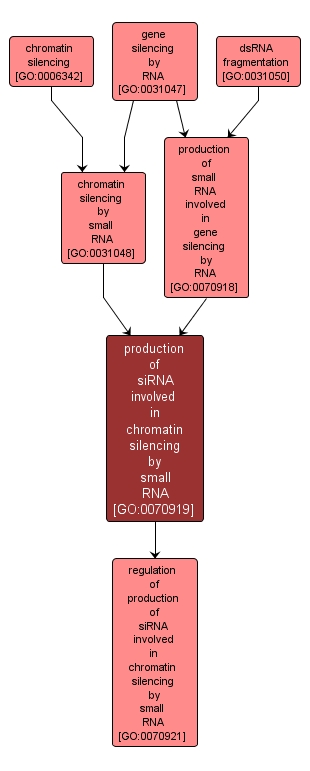
GO:0070919 - production of siRNA involved in chromatin silencing by small RNA (interactive image map)

YRC Informatics Platform - Version 3.0
Created and Maintained by: Michael Riffle