YRC Logo
PROTEIN SEARCH:
Descriptions Names[Advanced Search]

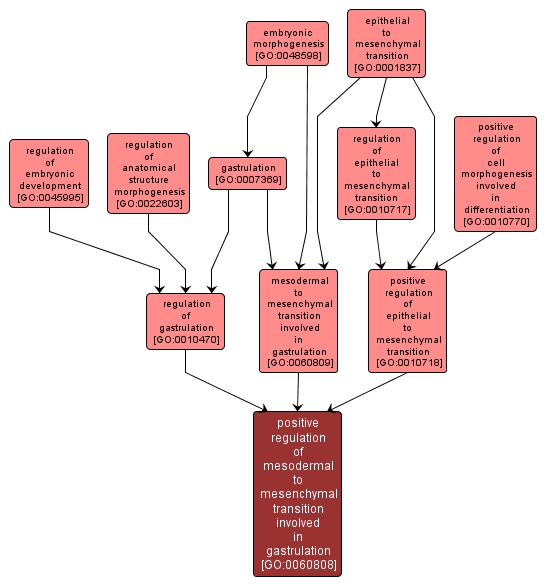
Any process that modulates the frequency, rate or extent of embryonic development. A complex and coordinated series of cellular movements that occurs at the end of cleavage during embryonic development of most animals. The details of gastrulation vary from species to species, but usually result in the formation of the three primary germ layers, ectoderm, mesoderm and endoderm. Any process that increases the rate, frequency, or extent of epithelial to mesenchymal transition. Epithelial to mesenchymal transition where an epithelial cell loses apical/basolateral polarity, severs intercellular adhesive junctions, degrades basement membrane components and becomes a migratory mesenchymal cell. Any process that modulates the frequency, rate or extent of anatomical structure morphogenesis. Any process that modulates the rate or extent of gastrulation. Gastrulation is the complex and coordinated series of cellular movements that occurs at the end of cleavage during embryonic development of most animals. Any process that modulates the rate, frequency, or extent of epithelial to mesenchymal transition. Epithelial to mesenchymal transition where an epithelial cell loses apical/basolateral polarity, severs intercellular adhesive junctions, degrades basement membrane components and becomes a migratory mesenchymal cell. A transition where an epithelial cell loses apical/basolateral polarity, severs intercellular adhesive junctions, degrades basement membrane components and becomes a migratory mesenchymal cell. The process by which anatomical structures are generated and organized during the embryonic phase. Morphogenesis pertains to the creation of form. The embryonic phase begins with zygote formation. The end of the embryonic phase is organism-specific. For example, it would be at birth for mammals, larval hatching for insects and seed dormancy in plants. The epithelial to mesenchymal transition process in which a mesodermal cell loses apical/basolateral polarity, severs intercellular adhesive junctions, degrades basement membrane components and becomes a migratory mesenchymal cell as part of the process of gastrulation. Any process that increases the rate, frequency, or extent of epithelial to mesenchymal transition. Epithelial to mesenchymal transition where a mesodermal cell loses apical/basolateral polarity, severs intercellular adhesive junctions, degrades basement membrane components and becomes a migratory mesenchymal cell as part of the process of gastrulation. Any process that increases the frequency, rate or extent of cell morphogenesis contributing to cell differentiation. Cell morphogenesis involved in differentiation is the change in form (cell shape and size) that occurs when relatively unspecialized cells acquire specialized structural and/or functional features that characterize the cells, tissues, or organs of the mature organism or some other relatively stable phase of the organism's life history.

View Gene Ontology (GO) Term

GO TERM SUMMARY

Name: positive regulation of mesodermal to mesenchymal transition involved in gastrulation
Acc: GO:0060808
Aspect: Biological Process
Desc: Any process that increases the rate, frequency, or extent of epithelial to mesenchymal transition. Epithelial to mesenchymal transition where a mesodermal cell loses apical/basolateral polarity, severs intercellular adhesive junctions, degrades basement membrane components and becomes a migratory mesenchymal cell as part of the process of gastrulation.
Proteins in PDR annotated with:
   This term: 0
   Term or descendants: 0


[geneontology.org]
INTERACTIVE GO GRAPH

GO:0060808 - positive regulation of mesodermal to mesenchymal transition involved in gastrulation (interactive image map)

YRC Informatics Platform - Version 3.0
Created and Maintained by: Michael Riffle