YRC Logo
PROTEIN SEARCH:
Descriptions Names[Advanced Search]

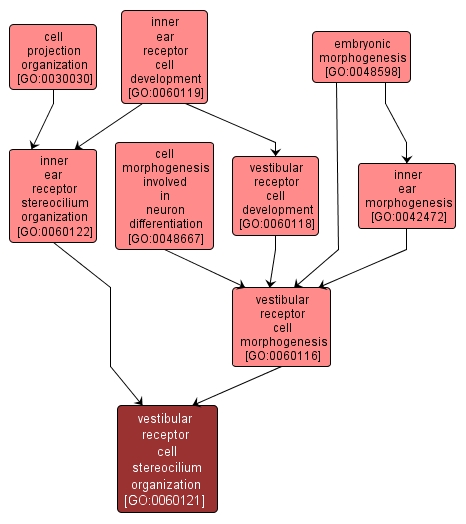
A process that is carried out at the cellular level which results in the assembly, arrangement of constituent parts, or disassembly of a stereocilium. A stereocilium is an actin-based protrusion from the apical surface of vestibular hair cells. The process by which the anatomical structures of the inner ear are generated and organized. Morphogenesis pertains to the creation of form. The inner ear is the structure in vertebrates that contains the organs of balance and hearing. It consists of soft hollow sensory structures (the membranous labyrinth) containing fluid (endolymph) surrounded by fluid (perilymph) and encased in a bony cavity (the bony labyrinth). It consists of two chambers, the sacculus and utriculus, from which arise the cochlea and semicircular canals respectively. A process that is carried out at the cellular level which results in the assembly, arrangement of constituent parts, or disassembly of a stereocilium. A stereocilium is an actin-based protrusion from the apical surface of inner ear receptor cells. The process by which the structures of a neuron are generated and organized. This process occurs while the initially relatively unspecialized cell is acquiring the specialized features of a neuron. A process that is carried out at the cellular level which results in the assembly, arrangement of constituent parts, or disassembly of a prolongation or process extending from a cell, e.g. a flagellum or axon. The process whose specific outcome is the progression of a vestibular receptor cell over time, from its formation to the mature structure. Cell development does not include the steps involved in committing a cell to a specific fate. The process whose specific outcome is the progression of an inner ear receptor cell over time, from its formation to the mature structure. Cell development does not include the steps involved in committing a cell to a specific fate. The process by which anatomical structures are generated and organized during the embryonic phase. Morphogenesis pertains to the creation of form. The embryonic phase begins with zygote formation. The end of the embryonic phase is organism-specific. For example, it would be at birth for mammals, larval hatching for insects and seed dormancy in plants. Any process that alters the size or shape of a vestibular receptor cell.

View Gene Ontology (GO) Term

GO TERM SUMMARY

Name: vestibular receptor cell stereocilium organization
Acc: GO:0060121
Aspect: Biological Process
Desc: A process that is carried out at the cellular level which results in the assembly, arrangement of constituent parts, or disassembly of a stereocilium. A stereocilium is an actin-based protrusion from the apical surface of vestibular hair cells.
Synonyms:
  • vestibular receptor cell stereocilium organization and biogenesis
  • vestibular hair cell stereocilium organization
Proteins in PDR annotated with:
   This term: 0
   Term or descendants: 0


[geneontology.org]
INTERACTIVE GO GRAPH

GO:0060121 - vestibular receptor cell stereocilium organization (interactive image map)

YRC Informatics Platform - Version 3.0
Created and Maintained by: Michael Riffle