YRC Logo
PROTEIN SEARCH:
Descriptions Names[Advanced Search]

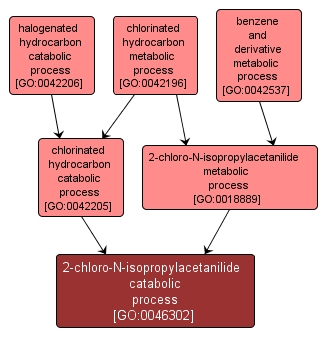
The chemical reactions and pathways resulting in the breakdown of 2-chloro-N-isopropylacetanilide, an acylanide herbicide widely used to protect corn, onion, cabbage, rose bushes, and ornamental plants. The chemical reactions and pathways resulting in the breakdown of halogenated hydrocarbons, any hydrocarbon with one or more halogen atoms attached to it. The chemical reactions and pathways resulting in the breakdown of chlorinated hydrocarbons, any hydrocarbon with one or more chlorine atoms attached to it. The chemical reactions and pathways involving benzene, C6H6, a volatile, very inflammable liquid, contained in the naphtha produced by the destructive distillation of coal, from which it is separated by fractional distillation, or any of its derivatives. The chemical reactions and pathways involving 2-chloro-N-isopropylacetanilide, an acylanide herbicide widely used to protect corn, onion, cabbage, rose bushes, and ornamental plants. The chemical reactions and pathways involving chlorinated hydrocarbons, any hydrocarbon with one or more chlorine atoms attached to it.

View Gene Ontology (GO) Term

GO TERM SUMMARY

Name: 2-chloro-N-isopropylacetanilide catabolic process
Acc: GO:0046302
Aspect: Biological Process
Desc: The chemical reactions and pathways resulting in the breakdown of 2-chloro-N-isopropylacetanilide, an acylanide herbicide widely used to protect corn, onion, cabbage, rose bushes, and ornamental plants.
Synonyms:
  • 2-chloro-N-isopropylacetanilide degradation
  • 2-chloro-N-isopropylacetanilide catabolism
  • 2-chloro-N-isopropylacetanilide breakdown
Proteins in PDR annotated with:
   This term: 0
   Term or descendants: 0


[geneontology.org]
INTERACTIVE GO GRAPH

GO:0046302 - 2-chloro-N-isopropylacetanilide catabolic process (interactive image map)

YRC Informatics Platform - Version 3.0
Created and Maintained by: Michael Riffle