YRC Logo
PROTEIN SEARCH:
Descriptions Names[Advanced Search]

A developmental process, independent of morphogenetic (shape) change, that is required for the medulla oblongata to attain its fully functional state. The medulla oblongata lies directly above the spinal cord and controls vital autonomic functions such as digestion, breathing and the control of heart rate. A developmental process, independent of morphogenetic (shape) change, that is required for the inferior olivary nucleus to attain its fully functional state. The inferior olivary nucleus is a capsule-shaped structure in the ventral medulla located just lateral and dorsal to the medullary pyramids. Neurons in the inferior olivary nucleus are the source of climbing fiber input to the cerebellar cortex; these neurons have been implicated in various functions, such as learning and timing of movements. A developmental process, independent of morphogenetic (shape) change, that is required for an anatomical structure to attain its fully functional state. The process whose specific outcome is the progression of the inferior olivary nucleus over time, from its formation to the mature structure. The inferior olivary nucleus is a capsule-shaped structure in the ventral medulla located just lateral and dorsal to the medullary pyramids. Neurons in the inferior olivary nucleus are the source of climbing fiber input to the cerebellar cortex; these neurons have been implicated in various functions, such as learning and timing of movements. A developmental process, independent of morphogenetic (shape) change, that is required for the hindbrain to attain its fully functional state. The hindbrain is the region consisting of the medulla, pons and cerebellum. Areas of the hindbrain control motor and autonomic functions. The biological process whose specific outcome is the progression of a neural nucleus from its initial condition to its mature state. A neural nucleus is an anatomical structure consisting of a discrete aggregate of neuronal soma. A developmental process, independent of morphogenetic (shape) change, that is required for an anatomical structure, cell or cellular component to attain its fully functional state. The biological process whose specific outcome is the progression of an anatomical structure from an initial condition to its mature state. This process begins with the formation of the structure and ends with the mature structure, whatever form that may be including its natural destruction. An anatomical structure is any biological entity that occupies space and is distinguished from its surroundings. Anatomical structures can be macroscopic such as a carpel, or microscopic such as an acrosome. The process whose specific outcome is the progression of the medulla oblongata over time, from its formation to the mature structure. The medulla oblongata lies directly above the spinal cord and controls vital autonomic functions such as digestion, breathing and the control of heart rate.

View Gene Ontology (GO) Term

GO TERM SUMMARY

Name: inferior olivary nucleus maturation
Acc: GO:0021717
Aspect: Biological Process
Desc: A developmental process, independent of morphogenetic (shape) change, that is required for the inferior olivary nucleus to attain its fully functional state. The inferior olivary nucleus is a capsule-shaped structure in the ventral medulla located just lateral and dorsal to the medullary pyramids. Neurons in the inferior olivary nucleus are the source of climbing fiber input to the cerebellar cortex; these neurons have been implicated in various functions, such as learning and timing of movements.
Synonyms:
  • inferior olive maturation
Proteins in PDR annotated with:
   This term: 0
   Term or descendants: 0


[geneontology.org]
INTERACTIVE GO GRAPH

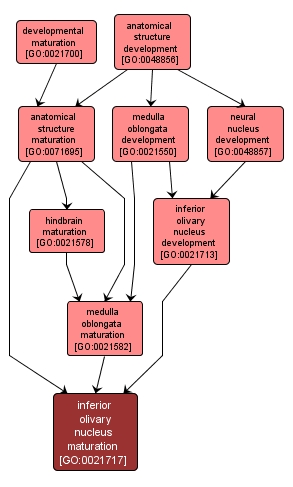
GO:0021717 - inferior olivary nucleus maturation (interactive image map)

YRC Informatics Platform - Version 3.0
Created and Maintained by: Michael Riffle