YRC Logo
PROTEIN SEARCH:
Descriptions Names[Advanced Search]

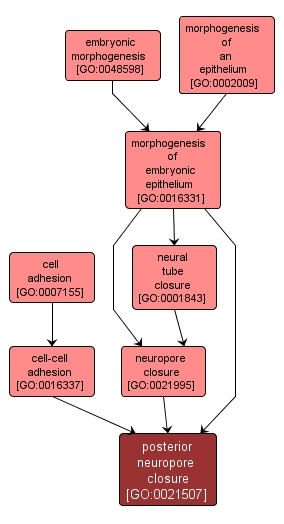
The process of joining together the neural folds at either end of the neural tube. The attachment of one cell to another cell via adhesion molecules. The process by which the anatomical structures of embryonic epithelia are generated and organized. Morphogenesis pertains to the creation of form. The last step in the formation of the neural tube, where the paired neural folds are brought together and fuse at the dorsal midline. The process by which anatomical structures are generated and organized during the embryonic phase. Morphogenesis pertains to the creation of form. The embryonic phase begins with zygote formation. The end of the embryonic phase is organism-specific. For example, it would be at birth for mammals, larval hatching for insects and seed dormancy in plants. The attachment of a cell, either to another cell or to an underlying substrate such as the extracellular matrix, via cell adhesion molecules. The process by which the anatomical structures of epithelia are generated and organized. Morphogenesis pertains to the creation of form. An epithelium consists of closely packed cells arranged in one or more layers, that covers the outer surfaces of the body or lines any internal cavity or tube. The joining together of the neural folds of the caudal opening of the neural tube. The posterior neuropore appears before the process of neural tube closure is complete.

View Gene Ontology (GO) Term

GO TERM SUMMARY

Name: posterior neuropore closure
Acc: GO:0021507
Aspect: Biological Process
Desc: The joining together of the neural folds of the caudal opening of the neural tube. The posterior neuropore appears before the process of neural tube closure is complete.
Proteins in PDR annotated with:
   This term: 0
   Term or descendants: 0


[geneontology.org]
INTERACTIVE GO GRAPH

GO:0021507 - posterior neuropore closure (interactive image map)

YRC Informatics Platform - Version 3.0
Created and Maintained by: Michael Riffle