YRC Logo
PROTEIN SEARCH:
Descriptions Names[Advanced Search]

The process by which an antigen-presenting cell expresses a peptide antigen of exogenous origin on its cell surface in association with an MHC class II protein complex. The peptide antigen is typically, but not always, processed from a whole protein. The process by which an antigen-presenting cell expresses antigen (peptide or lipid) on its cell surface in association with an MHC protein complex. The process by which an antigen-presenting cell expresses peptide antigen in association with an MHC protein complex on its cell surface, including proteolysis and transport steps for the peptide antigen both prior to and following assembly with the MHC protein complex. The peptide antigen is typically, but not always, processed from an endogenous or exogenous protein. The process by which an antigen-presenting cell expresses antigen (peptide or lipid) of exogenous origin on its cell surface in association with an MHC protein complex. The process by which an antigen-presenting cell expresses a peptide antigen of exogenous origin on its cell surface in association with an MHC class I protein complex. The peptide antigen is typically, but not always, processed from a whole protein. Class I here refers to classical class I molecules. The process by which an antigen-presenting cell expresses a peptide antigen of exogenous origin on its cell surface in association with an MHC protein complex. The peptide is typically a fragment of a larger exogenous protein which has been degraded within the cell. The process by which an antigen-presenting cell expresses a peptide antigen of exogenous origin on its cell surface in association with an MHC class Ib protein complex. The peptide is typically a fragment of a larger exogenous protein which has been degraded within the cell. Class Ib here refers to non-classical class I molecules, such as those of the HLA-E gene family.

View Gene Ontology (GO) Term

GO TERM SUMMARY

Name: antigen processing and presentation of exogenous peptide antigen
Acc: GO:0002478
Aspect: Biological Process
Desc: The process by which an antigen-presenting cell expresses a peptide antigen of exogenous origin on its cell surface in association with an MHC protein complex. The peptide is typically a fragment of a larger exogenous protein which has been degraded within the cell.
Synonyms:
  • exogenous peptide antigen processing and presentation
Proteins in PDR annotated with:
   This term: 0
   Term or descendants: 81 [Search]


[geneontology.org]
INTERACTIVE GO GRAPH

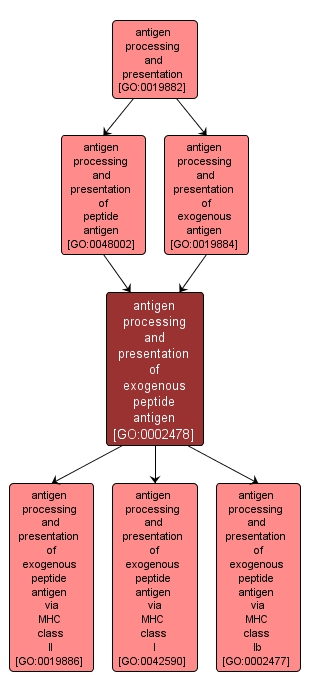
GO:0002478 - antigen processing and presentation of exogenous peptide antigen (interactive image map)

YRC Informatics Platform - Version 3.0
Created and Maintained by: Michael Riffle